
Featured Speaker
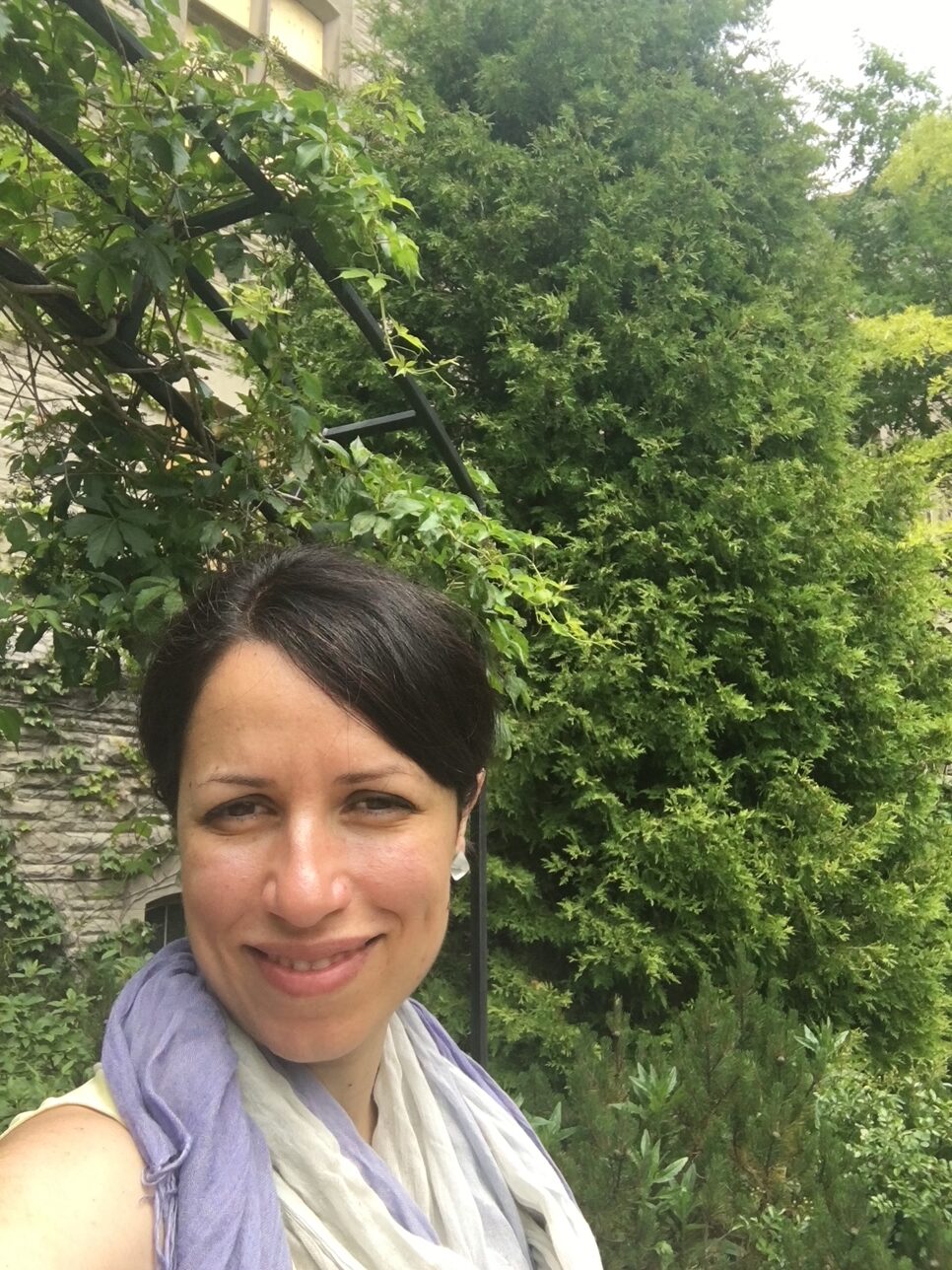
Dr. Yasaman Rafat
Associate Professor, Department of Languages & Cultures, Western University
About the Speaker
Dr. Yasaman Rafat is an Associate Professor in the Department of Languages & Cultures at Western University, where she directs the Second Language Acquisition and Multilingualism Lab. She is also affiliated with the Brain & Mind Institute, the Western Institute for Neuroscience, the Linguistics program, and Migration and Ethnic Relations.
She completed undergraduate studies in Italian and Spanish, an MA in Hispanic Linguistics (1998), and a PhD in Hispanic Linguistics (2011) at the University of Toronto, and has been at Western ever since. She has knowledge of Spanish, English, Farsi, Italian, and Serbian. Her collaborative research draws on a range of methods — including acoustic analysis, eye-tracking, and neuroscientific techniques — to study speech production and perception and to understand speech learning and language change across bilingual and multilingual populations. Her work has been supported primarily by SSHRC.
The Talk
From Correcting Accents to Training Listeners: A New Paradigm in Pronunciation Pedagogy
Language and linguistics programs have long emphasized “native-speakerism” — described by Holliday (2006) as the pervasive belief that “native-speaker” teachers embody a Western culture from which the ideals of a language and its teaching supposedly spring. Though widely criticized, this ideology remains deeply embedded in second-language education. Phonetics and pronunciation courses in particular tend to teach a single “standard” or “prestige” variety without exposing learners to a language’s full range of varieties (Colantoni, Escudero, Marrero-Aguiar & Steele, 2021), placing the entire burden of acquiring “native-like” speech on the learner.
The consequences are well documented: accented speech is frequently the target of ridicule (Bhatia, 2018) and is often perceived as less intelligent (Fiske, Cuddy, Glick & Xu, 2018) and less intelligible (Beinhoff, 2014). Yet research links these negative perceptions to listeners’ lack of exposure to accented speech (Kennedy & Trofimovich, 2008), and shows that greater exposure reduces listening effort and improves social judgments of the speaker (Rovetti, Sumantry & Russo, 2023).
This talk will (1) describe classical pronunciation-training methods, (2) review research on accent perception and attitudes, (3) call for a more equitable approach to language teaching that shifts responsibility to all speakers of majority languages rather than learners alone, and (4) propose an accent-perception training program with an experiential component, in which learners encounter varied forms of their own language and bilingual speech of differing degrees of accentedness. Everyone has an accent; some — the so-called native-speaker accents — simply carry more power and prestige (Coelho, 2004). Communication is a two-way process, and its success rests with both parties. The talk therefore argues for training all speakers to recognize and value different accents, and to question the assumed superiority of any one of them.


Recent Comments